Tinnitus
I Made Nudi Arthana
Literatur Review
Tinnitus is symptoms that can associated with various causes and factors trigger . It Can impact negative in quality life causes insomnia, difficulty understand talk , disturbance concentration , depression , and difficulty emotional on the spot Work or at home . ( Flint.P , 2014)
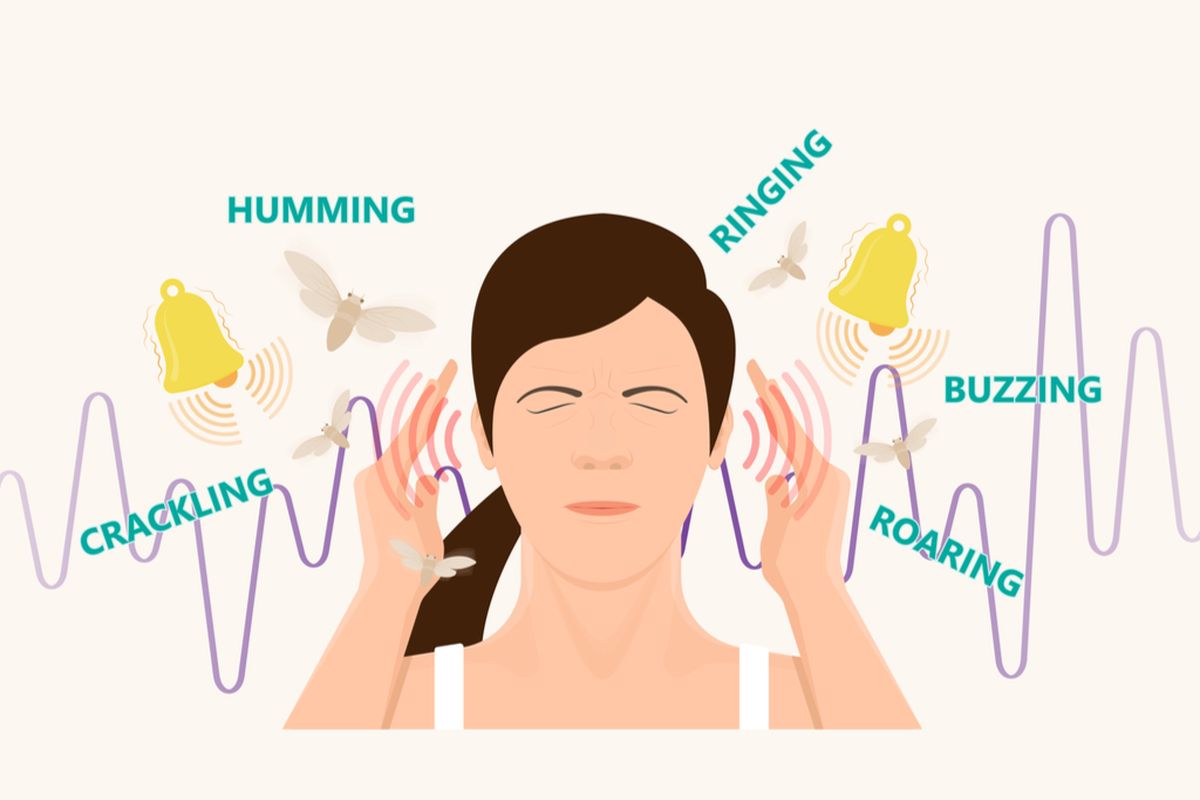
Picture 1 Tinnitus
Throughout population obtained 6% - 17% of population the experience ongoing not enough from 5 minutes . Estimated 10% -15% of population in the United States experience complaint tinnitus chronic And around 0.5% - 1% from population the with severe that affects life sufferers . The incidence rate increase along with increase age And existence disturbance hearing And especially consequence exposed voice noisy . increasing around double on all group age , with history exposed voice noisy . (JT Jhonson . 2006)
Prevalence in adults with problem hearing high (59 to 86%), and is estimated that appears in 50% of patients with disturbance hearing suddenly , 70% with presbyacusis , and 50 to 90% with disturbance hearing consequence noise . Most of the patient report experience problem including : disturbance sleep (42%), problems concentration (47%), and sensitivity to voice (33%). A study of 1,100 children conducted in Italy showed that 34% suffer and 6.5% complained . Tinnitus is also experienced by those who have normal hearing ; 18% of patients reported own normal hearing . Pregnancy has proven in a way significant increase possibility it . The severity of it is associated with severity anxiety and depression and it seems influence ability cognitive patient . (Flood, LM 2017)
There are various causes and sometimes it is difficult to know for sure. Here are some conditions that can cause someone to experience this condition: Damage to the inner ear. Normally, sound that enters the ear will be sent to the brain by the auditory nerves after passing through the cochlea. However, if there is damage to the cochlea, the signal sending process will stop and the brain will continue to search for signals from the remaining cochlea. Hearing loss due to aging. The sensitivity of the auditory nerve will decrease with age so that the quality of our hearing will decrease. Loud sounds or noises, for example listening to music that is too loud through earphones, factory workers handling heavy machinery, or hearing loud explosions. Buildup of wax in the ear. This will block hearing and can trigger irritation of the eardrum. Infection in the middle ear. Abnormal growth of the ear bones. Meniere's disease. Head or neck injury. Side effects of certain medications. Hyperthyroidism. Earthquake. Acoustic neuroma. Cardiovascular disorders, such as hypertension or atherosclerosis.
Some other sounds that may occur in people with tinnitus are:
Rumbling, Clicking, Hissing, Humming, Subjective tinnitus, only the sufferer can hear is the most common.
This ringing sound can range in pitch from a low roar to a high-pitched scream, and you may hear it in one or both ears.
In some cases, the sound can be so loud that it interferes with your ability to concentrate or hear external sounds. Symptoms may be present all the time, or they may come and go.
In rare cases, it can occur as a rhythmic pulsing or whooshing sound, often in conjunction with a heartbeat.
2.1.3 Classification
Tinnitus can also classified in a way qualitative as pulsatile ( often objective ) and nonpulsatile ( usually subjective ). Nonpulsatile subjective is the most common and only heard by the sufferer , while pulsatile objective sometimes can heard by observer And due to by vibration or noise internal body . (Sanchez TG, 2005) Tinnitus can also shared into primary and secondary . Primary is not own causes that can identified and possibly related or No related with sensorineural deafness or sensorineural hearing loss (SNHL). In contrast , secondary own underlying cause or condition related ( outside of SNHL) ( Flint.P , 2014). Tinnitus is also divided become tinnitus I that is not enough from 3 months and tinnitus chronic more from 3 months . (Kreuzer, PM, 2013)
Tinnitus objective rare : even in the center reference , that only represents 1.5% of all complaint. Nonpulsatile tinnitus subjective so far This is type the most common tinnitus , representing about 90% of all tinnitus . ( Flint.P , 2014)
Classification according to Klockhoff and Lindblom tinnitus shared into 4 namely in accordance with table under This :
2.1.3.1 Degree Tinnitus ( Klockhoff and Lindblom., 1967)
| No | Degree | Explanation |
| 1 | 0 | No |
| 2 | 1 | Only heard in quiet environment |
| 3 | 2 | Tinnitus is only heard in normal surroundings, but is masked by environmental noise. Sometimes it disturbs sleep. |
| 4 | 3 | Tinnitus sounds louder than ambient sounds, interferes with sleep, can disrupt sleep in general, and is a predominant problem affecting quality of life. |
Tinnitus has connected with various factor risks , including infection in 10% of cases , injury head or neck in 17% of cases , exposure long-lasting noise in 22% of cases . Theory latest to put forward that system nerve center is source tinnitus . Based on inspection functional magnetic resonance imaging (fMRI) and Positron emission tomography (PET), indicate loss of cochlear input to neurons in the system auditory central as it happens in case of damage cell hair or lesion on the nerve vestibulocochlear cause abnormal neuronal activity in the cortex auditory . (Tyler, RS, 2009) . Persistent tinnitus ( lasting more than 6 months ), unilateral, or relate with difficulty hearing . ( Flint.P , 2014)
Theory damage or dysfunction that make existence signal tinnitus mention that signal generated at the level nucleus dorsal cochlea because activation that is not balance that comes from from cell hair outside and inside . In special , when cells hair outside No functioning in the area certain from basilar membrane and some cells hair in the same area Still functioning with Well , disinhibition in the dorsal cochlear nucleus occurs and may produce formation signal tinnitus . (Flood, LM 2017)
2.1. 5 Manifestation
Tinnitus classified based on assessment that includes 3 factors that is :
1) Factors psychology
2) Factors physiology and
3) Adjustment psychoacoustic
Ability identify factor physiology in a way objective and very helpful in classify Tinnitus . a way substantial consequence exposed voice noise and NIHL ( noise induced hearing loss ). Damage cochlea caused by noise possibility associated with the emergence tinnitus . Deafness from NIHL is cochlear and general sensorineural deafness happened on both ear . (Westcott, M. 2009.)
List of complaints related to reported by patients with tinnitus includes : 1) problems emotional , such as , anxiety , and depression ; 2) problems hearing like difficulty understand conversation ; and 3) problems somatic like Sick head , pain neck , and pain jaw . (Flood, LM 2017)
2.1.6.1 Anamnesis
Patient with complaint tinnitus must asked regarding , onset ( gradual or suddenly ) and nature sound ( quality , location ), effects in life everyday ( the effect to quality sleep , work , concentration , atmosphere heart , and activities social ), duration tinnitus and symptoms related , including difficulty hear . Medical history previously . ( Atik , A. 2014.)
2.1.6.2 Inspection Physical and Supporting
Evaluation comprehensive audiology must performed on patients with tinnitus accompanied by difficulty hearing , or MRI or computed tomography or CT Scan from temporal bone ) is indicated . (Magnusson, JE 2009.)
2.1.7 Therapy
Until moment This therapy For proven tinnitus effective Not yet found . It is can due to Because tinnitus Alone is symptom from various condition pathological with various mechanism different basis . (Liang J. 2021 )
Therapy varies from the simplest to the complex and requiring approach multidisciplinary from aspect physical and psychological tinnitus That alone . (C. Jerram. 2009.)
In patients with persistent and more severe tinnitus disturbing , can given other therapies such as use of sound generators ; tinnitus retraining therapy (TRT); and psychotherapy . (Thorne, PR 2009.)
In Table 1 it can be seen seen various therapy that can given for patient . (M. Martin. 2002.)
2.1.7.1 Therapy For Tinnitus Chronic
Tinnitus retraining therapy (TRT) is the intended technique For reduce impact auditory , emotional , and autonomous from tinnitus noise and with thus reduce response stress to tinnitus stimulus . After a history of tinnitus detailed , disturbance from tinnitus achieved with noise broadband delivered through device tinnitus ( noise generator ) used as tool help Listen and counsel non- standard psychology . Although No There is proof For intervention term short , TRT can under consideration For used as intervention term long .
2. 2 Music As Therapy ( Therapy Acoustic )
In general , humans from various eras, cultures , groups age , and community own the universal ability to can enjoy music . Music can become a medium for man For express teak himself . Besides That music can also own different roles in accordance condition psychological listeners , among other things, provide happiness and comfort , regulate emotions , as well as help relieve stress. (Plein, CT, 2015.)
2.2.2 Types Therapy Acoustic On Tinnitus
2.2.2.1 Hearing Aids
Patient with tinnitus accompanied by disturbance hearing should recommended For installation tool help hear (ABD). The use of ABD is intended For increase noisy environment so that can cover sound tinnitus and strengthening sound at a disturbed frequency . ( Ceranic B. 2008.)
2.2.2. 2 AIDS hear combination with noise generator
The presence a constant sound in the ear at a certain level certain will give effect therapeutic . The presence of noise generator will make tinnitus become No be noticed Again . ( Jastreboff , P.J. 2009.)
2.2.2.3 Personal listening devices
Devices This means all devices used by sufferers tinnitus in nature easy brought and can used in all condition environment . ( Särkämö T. 2018)
2.2.2.4 Tabletop sound generating devices .
Tabletop sound generating devices is device acoustics placed in place or room certain . Type voice like a waterfall or fan wind is type frequent sound used . (Wang S. 2018)
2.3 Stages Making from the beginning Tinnitus Application . (Lely Rahayu , 2022), (Lely Rahayu , 2023)
At the beginning study look for all over characteristics patient willing follow in study Good factor risk , amplitude , frequency , audiometry and others . Examination This covering measurement amplitude and frequency from tinnitus participants , then match repeat whether in accordance with each participant . The amplitude and frequency according to participant in accordance We use as a basic tone from making Tinnitus Song .
2.3.2 Customizing Tinnitus Songs according to with frequency and amplitude tinnitus patient
The song de Tinnitus that has been made Then We do checking what is the average frequency Already similar with frequency every sufferer with using the program and we also play song the using speakers and measuring frequency song through the speaker with application .
2.3.3 Merging Tinnitus Songs with sound generator so that become Music de Tinnitus
The song de Tinnitus that has been in accordance the frequency when measured with each sufferer so We merge with a sound generator that has frequency 15,000 Hz to 20,000 Hz and frequency below 250 Hz as addition Then tested repeat for average frequency so that obtained the appropriate average frequency with each sufferers . The song de Tinnitus that has been merged with sound generator This called Music de Tinnitus. Music de Tinnitus 's tested repeat with method like on For ensure same frequency with each participant .
2.3.4 Creation Tinnitus Application
This Tinnitus Music made application For player songs on Android using android studio application so Can installed on every Android cellphone that will be . In the application the added A little code for application running at the appropriate amplitude with each participant . The application has been So Then played use the speaker and be seen frequency and amplitude from music the when Already in accordance with frequency and amplitude patient so application the Already Ready given to participant research . Application This We call Tinnitus Application .
Evaluation tinnitus using 3 ratings effectivewith Tinnitus Handicap Inventory (THI) and Questionnaire Tinnitus Primary Function Questionnaire 12-item (TPFQ) whereas in a way subjective with Visual Analog Scale (VASE)
2.4.1 Tinnitus Handicap Inventory (THI)
Evaluation For tinnitus used with Tinnitus Handicap Inventory (THI). Which contains scoring like under this : ( Priyanto , Agus , 2017)
Name :… …………………………….. Date :… ……….
Age :… ……………………………..
Instructions : Purpose questionnaire This is For identify , measure , and evaluate difficulties you may experience Because tinnitus . Please Don't to miss question whatever . When you have answer all question , add up your total score , based on mark For every response .
Table 2.4.1.1 THI ( Priyanto , Agus , 2017)
NO | QUESTION | YES | SOMETIMES | NO | |||||||
1 | Whether tinnitus cause You difficult For concentrate ? | ||||||||||
2 | Whether hard voice tinnitus cause You difficult hear conversation ? | ||||||||||
3 | Does tinnitus cause you angry ? | ||||||||||
4 | Whether Confused ? | tinnitus | cause | You | |||||||
5 | Whether voice tinnitus always bother You ? | ||||||||||
6 | Because of tinnitus , is it You experience difficulty For Sleep at night day ? | ||||||||||
7 | Whether You feel as if No Can healed from tinnitus ? | ||||||||||
8 | Whether Your tinnitus is bothering you ability You For enjoy activity social ( like go Eat Evening , to cinema )? | ||||||||||
9 | Because tinnitus , whether You feel frustrated ? | ||||||||||
10 | Due to tinnitus , whether you feel experience serious illness ? | ||||||||||
11 | Whether Because tinnitus You feel difficult For enjoy life ? | ||||||||||
12 | Whether Your tinnitus is bothering you work or not quite enough answer House your stairs ? | ||||||||||
13 | Because tinnitus WhichYou suffering , do you often feel annoyed ? | ||||||||||
14 | Because tinnitus You,whether difficult for you to read ? | ||||||||||
15 | Do you feel that problem tinnitusYou has makeYou stress with connection member family and your friends ? | ||||||||||
16 | Do you feel difficult For divert attention You from You tinnitus And matter other ? | ||||||||||
17 | Whether You feel No Can control voice from tinnitus that you suffering ? |
|
|
|
18 | Because of the tinnitus you have suffering , is it You feel tired ? |
|
|
|
19 | Because tinnitus You, whether You feel stressed ? |
|
|
|
20 | Whether tinnitus You make You feel worried ? |
|
|
|
21 | Whether You feel No Can Again overcome tinnitus ? |
|
|
|
22 | Whether tinnitus You increase critical while you are stressed ? |
|
|
|
23 | Is your tinnitus making you feel No believe self ? |
|
|
|
Total THI Score: ( sum ' Yes ' response x 4) + ( total response ' Sometimes ' x 2) = ................
Determine existence disturbance tinnitus is felt based on total THI score . Table 2.4.1.2
THI Score
SCORE | LEVEL HANDICAP |
0- 16: |
A little or No there is (Level 1) |
18- 36: | Light (Level 2) |
38- 56: | Medium (Level 3) |
58- 76: | Weight ( Level 4) |
78- 100 | Very heavy (Level 5) |
2.4.2 Tinnitus Primary Function Questionnaire 12-item (TPFQ)
Please mention your consent to every statement under This from value 0 ( completely No agree ) to 100 ( completely agree ) with multiples of 5.
Table 2.4.2.1 TPFQ ( Xin, Y et all , 2023)
No. |
Tinnitus makeI |
Mark |
1 |
Difficult concentrate moment do a number of work | |
2 |
Difficult concentrate moment do a workimportant | |
3 |
Difficult concentrate moment think | |
4 |
Easy angry | |
5 |
Stressed | |
6 |
Worried | |
7 |
Difficult hear part talks | |
8 |
Difficult hear and understand talks | |
9 |
More difficult understand than hear talks | |
10 |
Tired timeAfternoon Because No sleep well Sleep Evening | |
11 |
Awake momentSleep Evening | |
12 |
Difficult Sleep return after woke up moment Sleep Evening |
REFERENCE
Atik, A. 2014. Patophysiology and treatment: An Elusive Disease. Indian J Otolaryngol Head Neck Surg. 66(Suppl 1): 1–5.
Bailey, B. J. Dan J.T. Jhonson. 2014. Head and Neck Surgery Otolaryngology. 5th edition.
Bauer, C.A. 2018. . N Engl J Med 378:1224-31.
Ceranic B dan L.M Luxon. 2008. other dysacuses. Scott-Brown’s Otolaryngology, vol.3, 7th edition. Oxford: Taylor and Francis Group p.3594-628.
dos Santos, G. M., Bento, R. F., de Medeiros, I. R. T., Oiticcica, J., da Silva, E. C., & Penteado, S. (2014). The influence of sound generator associated with conventional amplification for control: randomized blind clinical trial. Trends in hearing, 18, 2331216514542657.
Flint, P. W., Haughey, B. H., Robbins, K. T., Thomas, J. R., Niparko, J. K., Lund, V. J., & Lesperance, M. M. (2014). Cummings otolaryngology-head and neck surgery e-book. Elsevier Health Sciences.
Flood, L. M. (2017). Ballenger's Otorhinolaryngology Head And Neck Surgery, 18th edn PA Wackym, JB Snow People's Medical Publishing House, 2016 ISBN 978 1 60795 177 3 pp 1523 Price£ 275.00. The Journal of Laryngology & Otology, 131(10), 937-938.
Geretsegger M, Mössler KA, Bieleninik Ł, Chen XJ, Heldal TO, Gold C. Music therapy for people with schizophrenia and schizophrenia-like disorders (Review). Cochrane Database of Systematic Reviews 2017;5.
Gökҫek E, Kaydu A. The effects of music therapy in patients undergoing septorhinoplasty surgery under general anesthesia. Braz J Otorhinolaryngol. 2020;86(4):419-426.
Graham, J., M. Martin. 2002. The Radiological Assessment of Hearing Loss. Ballantyness Deafness. Sixth Edition p.117-132.
Jastreboff, P.J. dan M.M. Jastreboff. 2009. Decreased Sound Tolerance. In: Snow JB, Wackym PA, editors. Ballenger’s Otorhinolaryngology Head and Neck Surgery 17. Connecticut: People’s Medical Publishing House Shelton; p.351-62.
Joundry, P., & Joundry, R. (2009). Sound therapy: music to recharge your brain.
Klockhoff, I., & Lindblom, U. (1967). Menière's disease and hydrochlorothiazide (Dichlotride®)—a critical analysis of symptoms and therapeutic effects. Acta oto-laryngologica, 63(2-3), 347-365.
Kreuzer, P. M., Vielsmeier, V., & Langguth, B. (2013). Chronic tinnitus: an interdisciplinary challenge. Deutsches Ärzteblatt International, 110(16), 278.
Liang J, Tian X, Yang W. Application of Music Therapy in General Surgical Treatment.Biomed Research International 2021. Article ID 6169183.
Loewy J. Music Therapy as a Potential Intervention for Sleep Improvement. Nature and Science of Sleep 2020; 12:1-9.
Rahayu, M. L., Pinatih, G. N. I., Setiawan, E. P., Lesmana, I. W. L., Pinatih, K. T. M. N., Arthana, I. M. N., & Widiantari, I. G. A. P. W. (2022). Development of a sound generator that matches the sound of tinnitus patient. Bali Medical Journal, 11(2), 1018-1022.
Rahayu, M. L., Setiawan, E. P., Sumerjana, I. K., Suryatika, I. B. M., Putra, I. W. G. A. E., Pinatih, K. T. M. N., ... & Widiantari, I. G. A. P. W. (2023). Making tinnitus songs according to the frequency and amplitude of the sound of sufferers that are safe and comfortable for sufferers. Indonesia Journal of Biomedical Science, 17(1), 28-32.
Magnusson, J.E. 2009. Similarities between chronic pain and tinitus: what we’ve learnedfrom chronic pain and how it applies to tinitus. The New Zealand Medical Journal, Proceeding of “Tinitus Discovery”: Asia-Pacific Tinitus Symposium. 11- 12 Sept 2009, Auckland, New Zealannd p. 51-56.
Mazurek, B., Hesse, G., Dobel, C., Kratzsch, V., Lahmann, C., & Sattel, H. (2022). Chronic Tinnitus: Diagnosis and Treatment. Deutsches Ärzteblatt International, 119(13), 219.
Nascimento, I. D. P., Almeida, A. A., Diniz, J., Martins, M. L., Freitas, T. M. M. W. C. D., & Rosa, M. R. D. D. (2019). Tinnitus evaluation: relationship between pitch matching and loudness, visual analog scale and tinnitus handicap inventory. Brazilian journal of otorhinolaryngology, 85, 611-616.
Plein, C. T., J. Harounian, E. Floyd, R. Irizarry, G. Ferzli, S. Kidwai, dan R.M. Rosenfeld. 2015. A Systematic Review of Eligibility and Outcomes in Tinitus Trials. Otolaryngology-Head and Neck Surgery 154(1):24–32.
Priyanto, Agus & Supriyadi, Didi & Wahyuningrum, Tenia. (2017). Perancangan Aplikasi Web Kuesioner Untuk Menilai Usability Perangkat Lunak Dengan Metode Rad (Rapid Application Development).
Sanchez T.G., M.P. Mak, M.E.B. Pedalini, C.P.D. Levy, dan R.F. Bento. 2005. ‘Evalucao do zumbido e da audicao em pacientes com audiometria tonal normal’. Int Arch Otorhinolarynol 9:220-7
Särkämö T. Cognitive, emotional, and neural benefits of musical leisure activities in aging and neurological rehabilitation: A critical review. Annals of Physical and Rehabilitation Medicine 2018; 61:414-418.
Schleuning, A.J. 1991. 2nd Management of the patient with tinnitus. Med Clin North Am 75(6):1225–37.
Searchfield, G.D., C. Jerram. 2009. Tinitus Assessment. The New Zealand Medical Journal, Proceeding of “Tinitus Discovery”: Asia-Pacific Tinitus Symposium. 11- 12 Sept 2009, Auckland, New Zealannd p. 101-109.
Snow, Jr., J. B. Ballenger, J. J. 2016. Ballenger’s Otorhinolaryngology Head and Neck Surgery. 18th edition.
Stegemann T, Geretsegger M, Quoc EP, Riedl H, Smetana M. Music Therapy and Other Music-Based Interventions in Pediatric Health Care: An Overview. Medicines 2019;6(25).
Thorne, P.R. 2009. Noise Induce Hearing Loss and Tinitus. The New Zealand Medical Journal, Proceeding of “Tinitus Discovery”: Asia-Pacific Tinitus Symposium. 11-12 Sept 2009, Auckland, New Zealannd p. 19-23.
Tyler, R.S., W. Noble, C. Coelho, G. Haskell, A. Bardia. 2009, Hyperacusis.
Wang S, Agius M. The Neuroscience of Music: A Review and Summary. Psychiatria Danubina 2018;30(7):588-594.
Westcott, M. 2009. Hyperacusis: A Clinical Perceptive on Understanding and Management. The New Zealand Medical Journal, Proceeding of “Discovery”: Asia-Pacific Tinitus Symposium. 11- 12 Sept 2009, Auckland, New Zealannd p. 155-159.
Wikipedia. Firebase Diakses pada 12 Desember 2022, dari
Xin, Y., Tyler, R., Yao, Z. M., Zhou, N., Xiong, S., Tao, L. Y., ... & Pan, T. (2023). assessment: Chinese version of the. Tinnitus Primary Function Questionnaire. World Journal of Otorhinolaryngology-Head and Neck Surgery, 9(01), 27-34.
Comments